
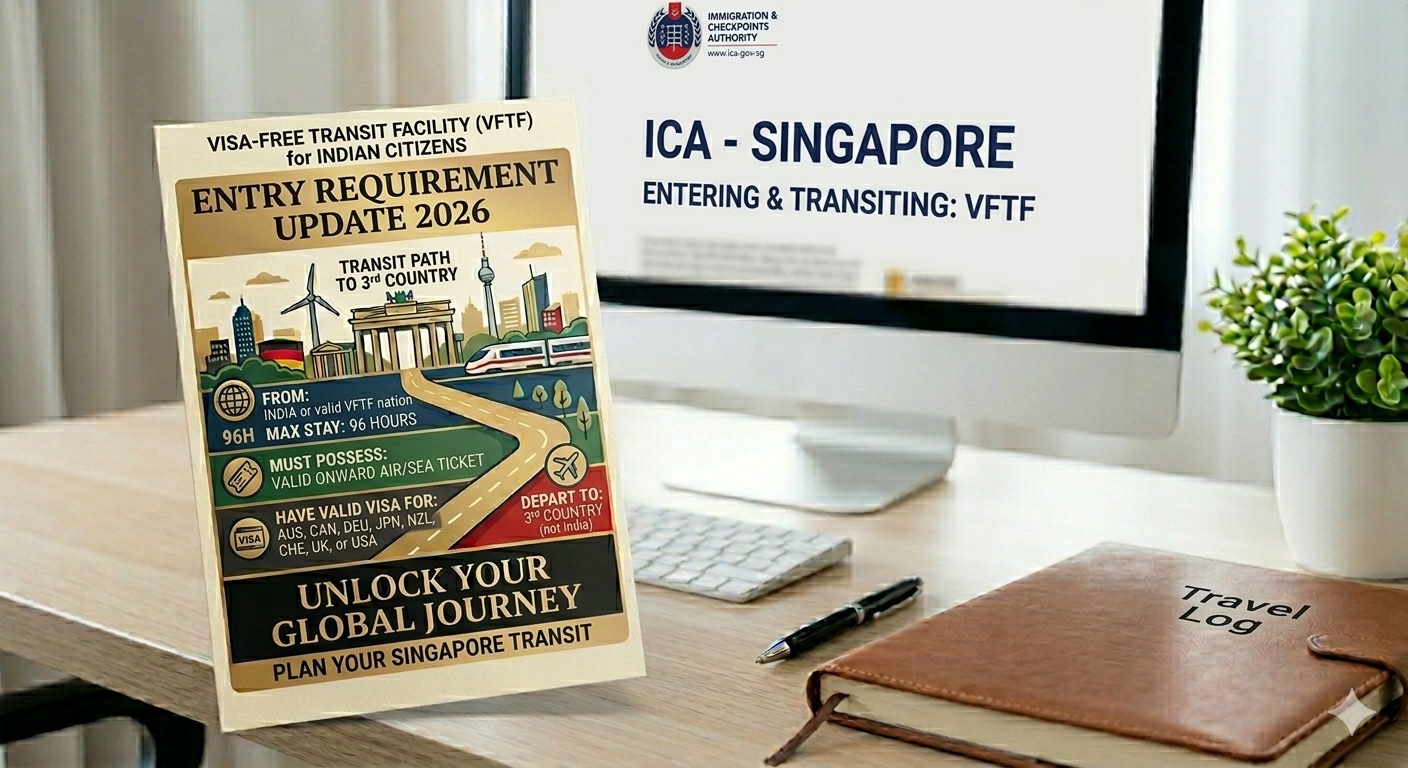
For Indian passport holders, Singapore is much more than just a convenient stopover – it’s a place in itself. With the world-famous Changi Airport, the breathtaking indoor showers at Jewel, and the famous Marina Bay Sands skyline, a stopover here is often a highlight of a trip. Historically, navigating visa requirements for a short stay can be an administrative headache. However, until 2026, the Visa-Free Transit Facility will remain in place, allowing eligible Indians to leave the airport and explore the city-state for up to 96 hours without having to apply for a standard tourist visa.
This comprehensive guide outlines the standard requirements, schedule variations, flight policies and step-by-step processes for Indian nationals wishing to use the Singapore VFTF in 2026.
1. What exactly is a Visa-Free Transit Facility VFTF?
First, it is very important to understand that the VFTF is not a visa. It is a conditional, short-term entry privilege granted at the sole discretion of ICA agents upon arrival at Changi Airport or a sea or land checkpoint in Singapore.
Since it is not an official visa, there is no pre-registration process, no website for uploading documents and no application fee. You simply approach the immigration desk, show your travel documents and ask for the VFTF entry.
2. Four Pillars of VFTF 2026 Qualification
To even be considered for the 96-hour VFTF, an Indian passport holder must meet all four basic requirements. Failure to meet even one of these conditions guarantees immediate rejection.
Pillar 1: Strict Passport Validity
Your Indian passport must be valid for at least six months from the actual date you intend to arrive in Singapore. If your passport expires in five months and twenty-nine days, your company will refuse to board you before you even leave India. This is an international transport standard that is not negotiated, but is tolerably implemented in Singapore.
Pillar 2: Third Country Transit Law.
VFTF is particularly relevant for travelers transiting through Singapore on their way to another final destination. Your journey should include three different countries: your country of origin, Singapore, and a third country of destination.
Pillar 3: Confirmed Onward Ticket.
You must have a confirmed, complete departure from Singapore within 96 hours of arrival. A dummy ticket or a simple flight reservation that is not fully paid and eBooked will not work; ICA officers have access to flight manifests and can verify the validity of your booking in real time.
Pillar 4: The Qualifying Third Country Visa
This is where the majority of confusion arises. To qualify for the VFTF, an Indian passport holder must possess a valid, unexpired long-term pass or visa from one of the following eight specific countries:
-
Australia
-
Canada
-
Germany
-
Japan
-
New Zealand
-
Switzerland
-
United Kingdom
-
United States of America
3. The Single Journey Visa Nuance
If you hold a multiple-entry visa for one of the eight approved countries, you can use the VFTF on both the forward and return legs of your journey, provided you meet the other criteria.
When you fly from India to Japan, your Japanese visa is valid and unused, so you easily qualify for VFTF. But what happens on the way back? Once you enter Japan, your single-entry visa is technically consumed or used, meaning it is no longer valid for future entries. Does this mean you cannot use VFTF on the flight back home?
The Singapore ICA provides a specific exception for this exact scenario. You are allowed to use the VFTF on the return leg of your journey using a consumed Single Journey Visa, but strictly under these two conditions:
- You must be traveling directly from the country that issued the SJV, transiting through Singapore, and heading directly back to your home country.
- You must not have returned to your home country since the SJV was last utilized.
4. Airline Policies, Separate Tickets, and Baggage Claims
One of the most stressful aspects of using the VFTF occurs before you even reach Singapore: dealing with airline ground staff at your departure airport.
Single PNR vs. Separate PNRs
If you book a single ticket from Delhi to Sydney via Singapore on Singapore Airlines, your luggage is checked all the way through to Sydney. During your layover, you can simply stay in the transit area of Changi Airport without needing to pass through immigration. If you choose to enter Singapore to sightsee, you can use the VFTF.
However, Indian travelers frequently use budget airlines to save money, booking self-transfer itineraries. For example, you might book Indi Go from Mumbai to Singapore, and a separate ticket on Scoot from Singapore to Melbourne.
If you do not have a standard Singapore e-Visa, your entire trip hinges on being granted the VFTF. Airline check-in staff in India are highly trained to look for this. If you show up at the Indi Go counter in Mumbai with a ticket to Singapore, no Singapore visa, and a separate ticket to Melbourne, they will scrutinize your eligibility for the VFTF. If they are not entirely satisfied that you meet the criteria, they will deny you boarding to avoid being fined by the Singapore government for flying an ineligible passenger.
5. The Step-by-Step Immigration Process at Changi
Navigating Changi Airport is famously efficient, but first-time VFTF users must follow a specific sequence of events to ensure a smooth entry.
1. Submit the SG Arrival Card (SGAC): Up to 3 days before arrival.
The SGAC is a mandatory electronic health and travel declaration. It is completely free and must be filled out via the official ICA website or the My ICA mobile app. Do not use fraudulent third-party websites that attempt to charge you $30-$50 for this free service.
2.Prepare Physical Documentation: Before landing.
While Singapore is highly digitized, immigration officers prefer physical proof during transit assessments. Print your onward flight ticket, your hotel booking, and ensure your passport with the qualifying third-country visa is easily accessible.
3.Proceed to Manual Immigration Counters: Upon arrival at Changi.
Singapore heavily utilizes automated biometric lanes. However, as an Indian national requesting VFTF for the first time, the automated gates will likely reject you because the system needs to verify your third-country visa and onward flight. Follow the signs to the manual All Passports counters.
4. The Assessment and e-Pass Issuance: At the counter.
Politely inform the officer you are transiting and utilizing the VFTF. They will verify your documents, take a digital scan of your fingerprints and irises, and process your entry. In 2026, Singapore will no longer physically stamp passports. Instead, an electronic Visit Pass stating your exact 96-hour deadline will be emailed to the address you provided on your SGAC.