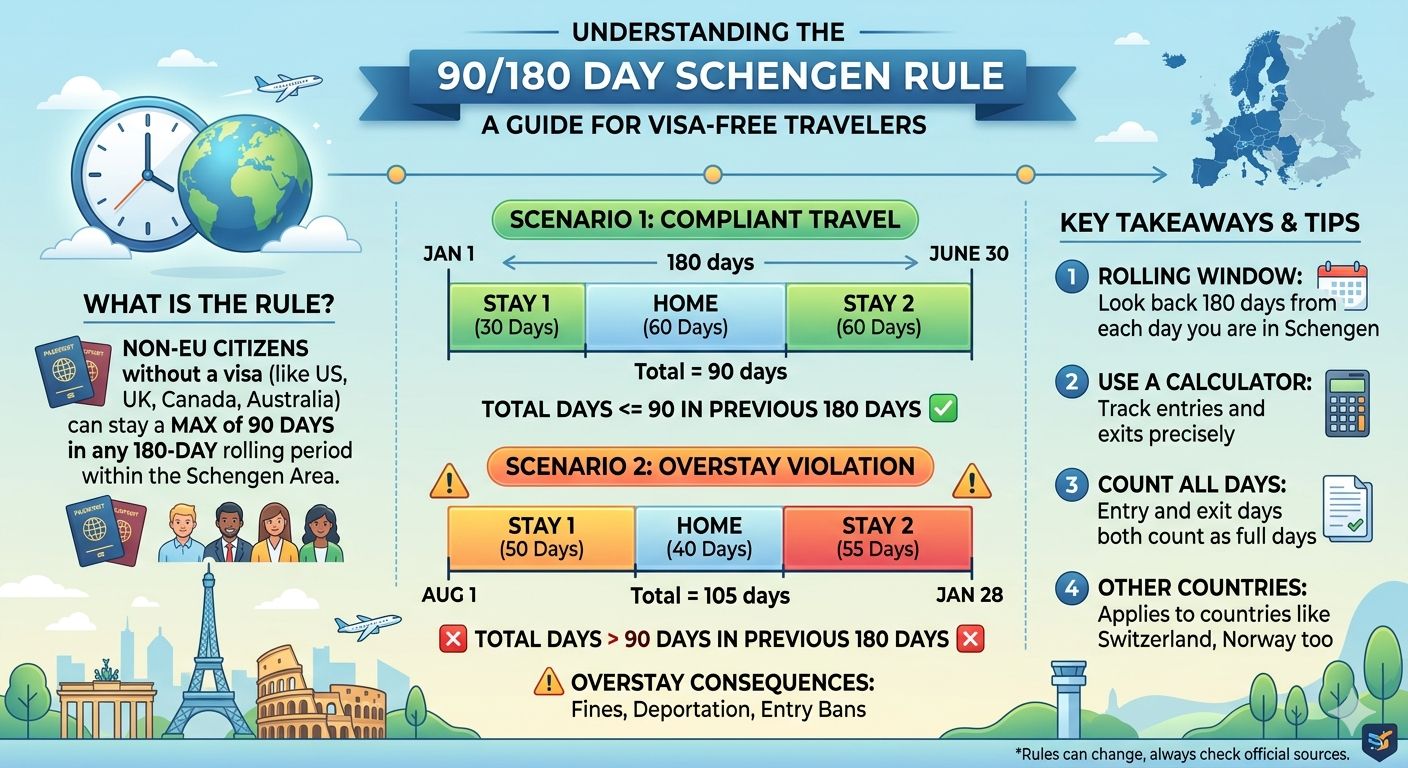
The 90/180 day Schengen rule has been the subject of an ongoing data collection process for several years. Travelers from visa-exempt countries, such as the United Kingdom, the United States, and Australia, often use blank stamps on their passports to record their stay in the 29 countries of the Schengen Area. It is a system prone to human error, where an illegible stamp or an unprepared border guard can lead to delays or, conversely, unreasonable checks.
As of 2026, this ambiguity has disappeared. With the full implementation of the Entry/Exit System and the launch of the European Travel Information and Authorization System (ETIAS), the European Union has moved towards a “smart border”. In this new digital space, the 90/180 day rule is not a recipe for manual accounting; This is an automated, high-risk measure that uses real-time biometric tracking.
Analysis of the 90/180 Day Rule
Before analyzing the digital rule, it is important to understand the calculation behind it. The regulation confirms that citizens of non-EU/EEA countries can stay in the Schengen Area for 90 days within 180 days.
The difficulty lies in the rotating nature of the 180-day period. To make sure you meet the rule, you should consider the last 180 days from the current date (or the date you want to enter/exit). If the total number of days in the Schengen Area during this period is equal to or less than 90, you are within the limit.
Key characteristics of the calculation:
- Rotating period: Each day you spend in the Schengen Area advances a 180-day period. Stays that occurred 181 days ago “thwart” the calculation. Entry/Departure Dates: Your arrival and departure days are considered full days in the Schengen Area, regardless of the landing or departure time of your flight.
- Total Duration: The 90 days do not have to be consecutive. You can enter and exit the area as many times as you like, as long as the total stays within the limit.
- Digital Transformation: EEA and the End of the Passport
The main change in 2026 will be the Entry/Exit System Fully operational at all external borders from April 10, 2026, the EEA has replaced the passport card with a digital database.
How Entry Exit System Works:
When crossing the Schengen border, the system now records your facial image and fingerprints, along with your passport data. More importantly, it records the exact date and location of every entry and exit.
EES is more than just a data logger; it is a working calculator. Upon entry, the system will check your history and let the border guard know how many days of your 90-day limit you have left. Once you have exceeded the limit, the system will mark your entry as “Not Authorized” and access will be denied.
Note to travellers: The EEA applies to all external borders of the 29 participating countries. However, it does not apply to travel within the Schengen Area (e.g. flights from Paris to Berlin). Domestic travel is not yet covered by the EEA, which means the 90-day limit applies to the whole territory, not just one country.
ETIAS: Pre-Travel Screening
While the EEA conducts screening at the border, ETIAS (scheduled to launch in the last quarter of 2026) conducts screening prior to your arrival. For visa-exempt travellers, ETIAS authorization is now a requirement for travel.
The ETIAS system is designed to identify individuals who may pose a risk of irregular migration or security concerns. By requiring travelers to provide personal information and online travel history, the EU can compare data with the EEA to ensure the traveler has not breached the 90/180-day rule. If their digital data shows a pattern of overstaying, their ETIAS application – and therefore their ability to board a flight – will be rejected.
The Risks of Overstaying in the Digital Era
In the “analog” days, an overstay of a day or two might have gone unnoticed by a busy official. In 2026, the digital border is unforgiving. The EES automatically flags “overstayers” the moment they attempt to exit the zone after their 90th day.
The Consequences in 2026:
-
Financial Penalties: Fines for overstaying vary by country but can reach several thousand euros, especially for significant breaches.
-
The “SIS” Alert: Overstayers are entered into the Schengen Information System (SIS). This digital “red flag” is visible to all member states, making future entry into any Schengen country extremely difficult.
-
Entry Bans: Serious or repeat offenders may face a formal re-entry ban, typically lasting between 3 and 5 years.
Strategies for Navigating the Digital Border
1. Utilize Official Digital Tools
The European Commission has released a Short-Stay Calculator.This tool allows you to input your previous and planned travel dates to see exactly when your 90-day limit expires. In 2026, checking this should be as routine as checking your flight time.
2. The “3-Month” Buffer
To account for unexpected delays—such as flight cancellations, strikes, or illness—it is wise to never plan a stay that uses all 90 days. Aiming for an 85-day maximum provides a safety net that prevents a minor travel hiccup from becoming a major immigration violation.
3. Know the Non-Schengen Refuges
If you are close to your 90-day limit but wish to stay in Europe, you must move to a country outside the Schengen Area. In 2026, this includes:
- The United Kingdom
- Ireland
- Cyprus
- The Balkan States
Special Considerations for Digital Nomads and Retirees
If your lifestyle involves staying in Europe for more than 90 days in a six-month period, you can no longer rely on the 90/180 day rule. You must instead apply for a Long-Stay Visa or a Residence Permit from a specific EU member state. These documents exempt you from the 90/180 day calculation within that specific country, though you are still restricted to the 90/180 rule for travel into other Schengen nations.