In global migration, 2024 marks a pivotal moment as Japan enters the digital nomad race. Now, in 2026, the “Certain Activities” visa for digital nomads has become the most sought-after and revised travel visa in Asia. While Japan has a blend of modern conveniences and deep-rooted tradition, its entry requirements are still among the most stringent in the world.
1. 10 Million Yen Threshold: Overcoming the Value of the Sticker
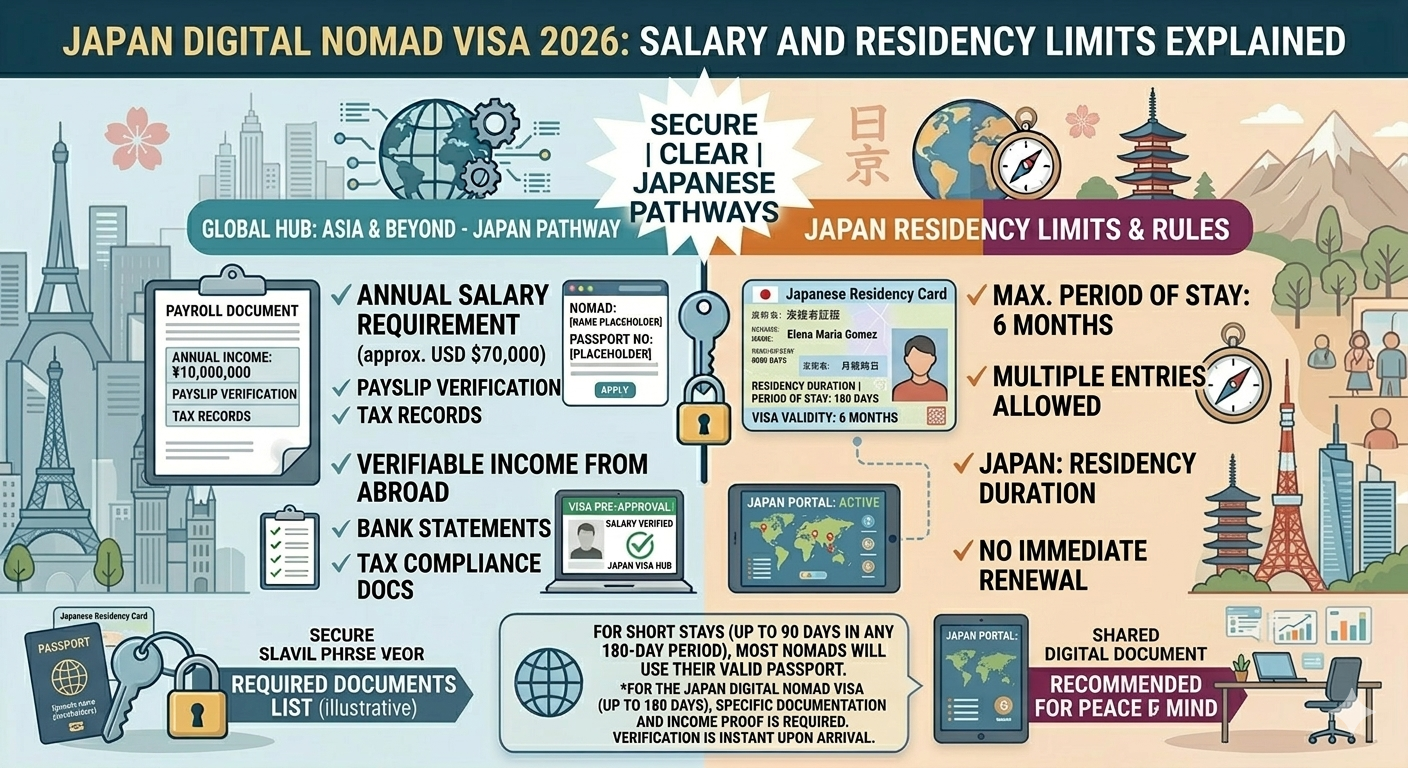
The most controversial aspect of the Japanese Digital Nomad Visa is the salary requirement. To be eligible, applicants must be able to show that they earn an annual salary of at least 10 million Japanese Yen.
In 2026, when the currency is converted, this means around $65,000 – $70,000 USD or €62,000 – €65,000.
What is considered “Proof of Income”?
Unlike European passports that accept income savings, Japan requires regular proof of income. You will need to show that you receive money from non-Japanese organizations or foreign clients.
For employees: You will need a clear employment contract stating your salary and a “letter of permission” from your employer stating that you can work remotely from Japan for the duration of your stay.
For self-employed workers/business owners: here 2026 the rules are stricter. You must prepare a contract with a business partner or client that clearly states the length of the contract and the amount of money to be paid. One-off payslips are generally not sufficient; ISAs look for a steady stream of income that demonstrates that you will not be seeking local employment in Japan.
Tax documents: Most employers will require a tax certificate or income tax return from your state tax authority.
Note: If you have changed jobs, you will need to provide bank statements for at least six months to prove that your current salary is a stable and consistent income, not a temporary increase.
2. Stay restrictions: Explain the “6-month rule”
The Japan Digital Nomad Visa is unique, and often criticized, for its short duration. While countries like Portugal or Spain offer a path to residency, the Japanese nomad visa is only for short stays.
Duration: 6 months.
Non-renewal: You cannot renew this visa while you are in Japan. After your 180 days, you must leave.
Going further: In 2026, a “cooling off” period will come into effect. You cannot apply for a second nomad visa now. Generally, you need to spend at least six months outside of Japan before you can apply for another 6-month digital nomad.
Why only 6 months?
The Japanese government limits visas to six months to comply with the 183-day tax rule. By limiting nomads to stay less than half the year, the Japanese Tax Agency avoids the trap of classifying these visitors as “Tax Residents.” As a holder of this visa, you are generally exempt from Japanese income tax on foreign earnings because you are considered a non-resident.
3. The “No Card Left Behind” Problem
This is the “hidden” problem with the Japanese digital nomad visa. Since the stay is only for six months, users do not receive a zairyu card. In Japan, residence cards are essential in everyday life. Otherwise, you will face several “Nomad Problems in Japan”:
- Residence: Most Japanese apartments still require a residence card to sign a lease. The nomads were sent to the “large apartments”.
-
Banking: You cannot open a local Japanese bank account. You must rely entirely on international cards and carry plenty of cash.
-
Sim Cards: While you can get “traveler” eSIMs easily, getting a long-term, low-cost Japanese phone contract usually requires a Residence Card.
4. Health Insurance: The 10 Million Yen Coverage
Japan is meticulous about ensuring foreign visitors do not become a burden on the national healthcare system. To get the visa, you must provide proof of private health insurance that covers injury, illness, and death with a minimum coverage of 10 million JPY.
-
The Certificate: You must provide an English or Japanese translation of your insurance policy summary.
-
Credit Card Insurance: In some cases, high-end credit card insurance is accepted, but only if you can provide a formal letter from the card issuer explicitly stating that the coverage meets the 10-million-yen requirement and covers the entire 6-month period.
5. Bringing Family: Spouses and Children
One of the major “wins” for the Japan Digital Nomad Visa is the ability to bring dependents.
- Eligibility: You can bring a legally married spouse and children.
- Income Math: Interestingly, Japan does not currently require you to show additional income for dependents (unlike many EU countries which require +20% or +30% per person). The 10 million JPY threshold covers the entire family unit.
- The Schooling Constraint: Because you are not “residents,” your children are not eligible to enroll in Japanese public schools. You must look into private international schools or, more commonly for this visa, continue homeschooling or remote learning.
6. Eligibility by Nationality
As of 2026, the visa is only available to citizens of approximately 50 countries and regions. These are typically nations that:
- Have a Visa-Exempt agreement with Japan.
- Have a Double Taxation Treaty with Japan.
This includes the USA, Canada, UK, most of the EU, Australia, New Zealand, Singapore, and South Korea. If your country is not on the list, you cannot apply for this specific visa, even if you earn 50 million yen a year.
Summary Table:
| Feature | Requirement / Detail |
| Annual Income | Min. 10 million |
| Visa Duration | 6 Months (Strict) |
| Renewability | No |
| Tax Residency | Non-Resident |
| Residence Card | Not Issued |
| Dependents | Spouse and Children allowed |
| Health Insurance | Min. 10 million JPY coverage required |
The Japan Digital Nomad Visa is designed for high-earning “slow travelers” rather than those looking to immigrate. If you want to spend a season snowboarding in Hokkaido or a spring under the cherry blossoms of Tokyo while working your US or European job legally, this is your path.