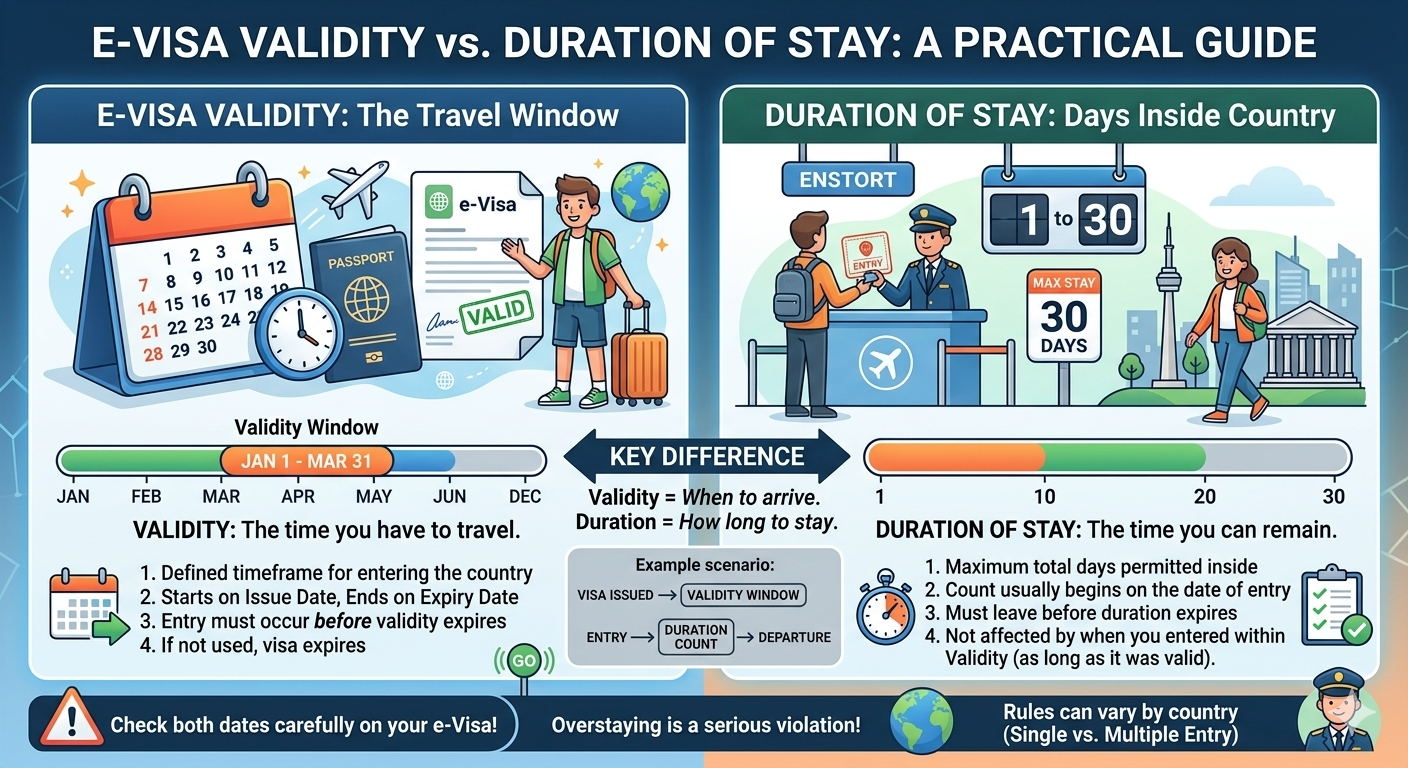
The digital revolution in international travel has replaced long lines at consulates and introduced technologically advanced websites and the ability to order PDF files. However, the success of e-visa services has created a new, often expensive, niche that attracts international travelers. Every year, thousands of tourists are turned away at airport gates or border crossings because they don’t understand two different numbers: the visa validity period and the duration of stay.
1. Defining the Variables: Validity vs. Duration
To understand the relationship between these two values, we need to define them in terms of travel time.
- Visa Validity: This is the period of time that the visa is “valid”.You can fly into the country and show up in person as soon as the window opens. If your visa is valid from January 1 to March 31 and you arrive on April 1, you will be denied entry – even if you want to stay overnight.
- Duration: This is the maximum number of consecutive days you can stay in the country after crossing the border. The clock starts ticking the moment an immigration officer stamps your passport or scans your QR code.
2. The “Full” Residence Trap: If the Time Window Closes Immediately
A traveler is seriously mistaken if they use to think their visa might expire.
Legislation: In almost all countries, the right of residence expires depending on which comes first: the end of the period in which they were granted the right of residence, or the end of the visa itself.
For example: 90/30 ratio
Imagine you have a Turkish visa.
Validity: 90 days.
Duration: 30 days.
Entering the country on January 10 starts the 30-day period. You must leave by February 8.However, if you enter the country on March 20, your “period of residence” (30 days) will be valid until April 19. You must leave by March 31. Waiting until April 19th will result in hefty fines, even if you haven’t used up your “30 days.”
3. Single-entry vs. multiple-entry Calculations
The math gets more complicated when using donor kits.
Online single-entry visas
For direct-entry visas (usually for Vietnam, Cambodia, or Egypt), the validity period can be much shorter—sometimes just 30 or 90 days. Once that entry visa is used up, the “employment status” becomes invalid and cannot be used in the future; it was “sufficient.” The only number that matters now is the length of stay. When you travel to a neighboring country, the visa is cancelled and you have to apply for a new visa to return.
Electronic multiple-entry visas
Multiple-entry visas (such as those from India or Saudi Arabia) are usually valid for a longer period. In this case, the validity period is based on the “Continue” rule.
One-year Indian Tourist Visa: Although this visa is valid for 365 days, many countries limit it to 90 or 180 days indefinitely.
How to calculate: You can enter and exit as many times as you like during the year, but you must reset the “Duration of Stay” counter before the 90 or 180 days have passed.
4. The “90/180 Rule”: The Schengen Complexity
For travelers within the Schengen area in Europe, the calculation is shifting from the average to the “open window” threshold. This is the most important time to determine the duration accurately.
Even if you have a multi-year visa, you will be subject to the 90/180-day rule. This means that at all times – including your expected departure date – you must count the last 180 days. If your total stay in the Schengen area exceeds 90 days, you are breaking the law.
5. Common “Hidden” Constraints
Beyond the primary numbers, three “hidden” factors can override your visa math:
-
Passport Expiration: Most e-Visa portals stipulate that your passport must be valid for at least 6 months beyond your date of arrival. If your passport expires on July 1, but your visa says you can stay until August 15, the immigration officer will usually curtail your “Duration of Stay” to match your passport’s end-life.
- The “Entry Buffer”: Some countries require that you enter within the first 30 days of the visa being issued, even if the “Validity” is listed as 90 days. Failure to arrive within that initial buffer can void the entire document.
- Administrative Extensions: In countries like Indonesia, a 30-day “Duration of Stay” can often be extended for another 30 days. However, the application for that extension must be made while your initial “Duration of Stay” is still valid—usually at least 7 days before it expires.
6. Summary Table: A Quick Reference
| Country Example | Typical Validity | Typical Duration of Stay | Key Math Constraint |
| Vietnam | 90 Days | 90 Days | Single or Multiple entry must be selected at application. |
| Turkey | 180 Days | 30 or 90 Days | Stay must not exceed the 180-day validity window. |
| India | 1 Year | 90/180 Days | 180-day limit is continuous; you must exit to reset. |
| Schengen | Variable | 90 Days | Uses the “Rolling 180-day” lookback window. |
| Saudi Arabia | 1 Year | 90 Days | Multiple entry; 90 days total per year. |
7. How to Proof Your Itinerary
To avoid a “Visa Math” catastrophe, follow these three steps before you pay for your flights:
- Map the “Hard Stop”: Identify the exact expiration date of your Visa Validity. Mark this in red on your calendar. Your feet must be outside the country by 11:59 PM on this date, regardless of how many “stay days” you think you have left.
- Calculate the “Midnight Rule”: Most countries count any portion of a day as a full day. If you land at 11:30 PM on Monday and leave at 1:00 AM on Wednesday, that counts as three days of stay not 25.5 hours.