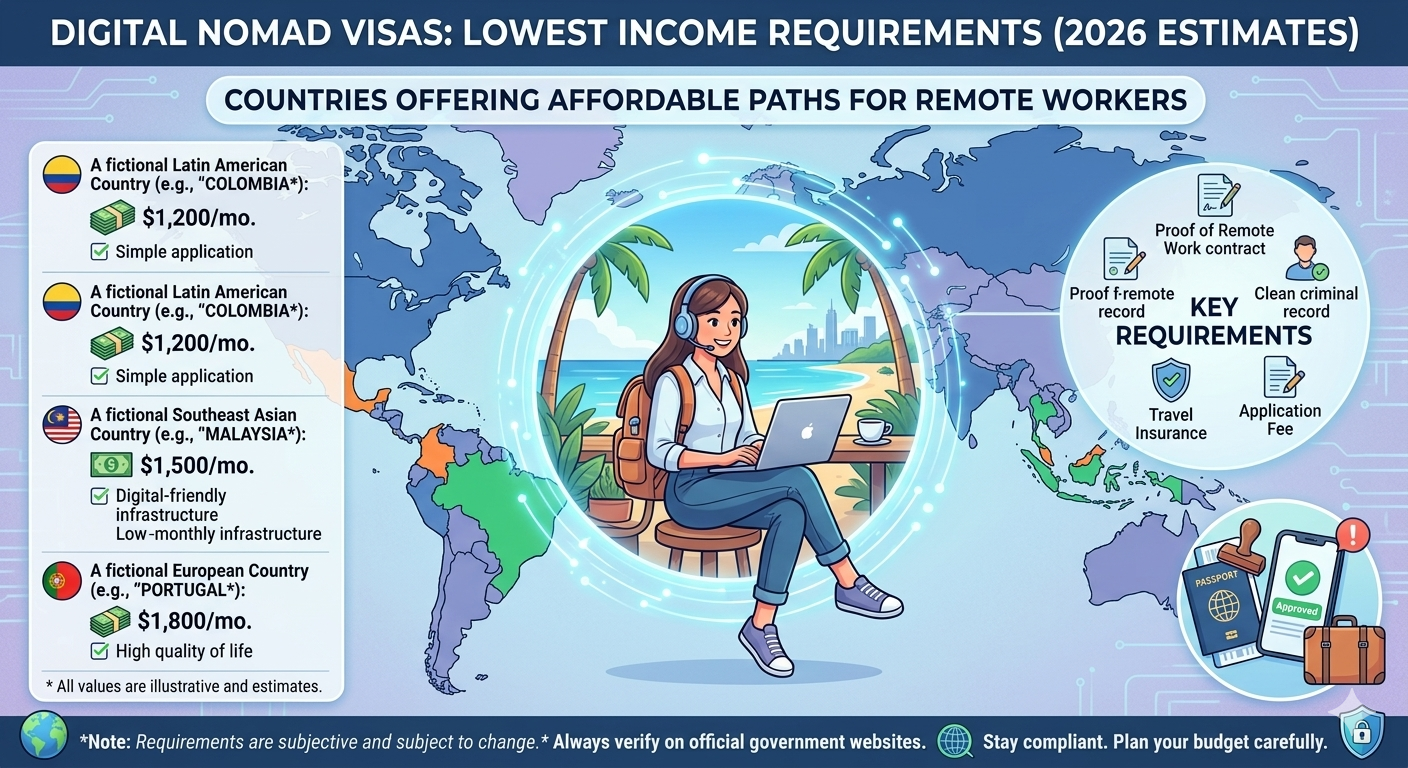
The era of the “borderless office” has reached a new stage of maturity in 2026. While early adopters in 2020 relied on legal grey areas and tourist visas, today’s digital nomads have access to over 60 official visa programs specifically designed for remote work. However, as these programs have become more regulated, many nations have raised their financial bars. Traditional favorites like Portugal and Spain now require monthly incomes exceeding $3,000 to $3,500, pushing the dream of “working from paradise” out of reach for many entry-level freelancers, teachers, and junior tech workers.
Fortunately, several countries have maintained—or newly introduced—accessible pathways. For those earning between $1,000 and $2,000 per month, or even those with no fixed monthly income requirement, the following destinations represent the most financially accessible digital nomad visas in 2026.
1. The “Zero Threshold” Tier: Low-Barrier Destinations
A handful of countries have opted for a “demonstrated self-sufficiency” model rather than a strict monthly salary floor. These programs are ideal for nomads with fluctuating freelance income or those living off modest savings.
Argentina: The Entry-Level Champion
In 2026, Argentina remains one of the most accessible spots for remote workers. Their digital nomad visa essentially has a $0 minimum income requirement. Instead of a fixed monthly salary, applicants must simply prove they are employed by a foreign company or have a steady stream of freelance clients.
-
The Logic: Argentina prioritizes attracting “human capital” and foreign currency. By demonstrating you have a job outside the country, you satisfy the requirement.
-
Stay Limit: 6 months, renewable for another 6 months.
-
Perk: One of the most favorable exchange rates for those earning in USD or EUR, making a modest salary feel like a small fortune.
Uruguay: Simplicity and Stability
Uruguay has branded its nomad visa as the “low-commitment” option. Like Argentina, it currently lists no specific minimum income. The application is entirely online and requires a sworn statement that you have the means to support yourself.
-
The Catch: While there is no floor, you must provide bank statements if requested. Typically, showing a balance that covers a year of local living (approx. $15,000) is sufficient.
-
Stay Limit: 6 to 12 months, with a clear path to residency if you decide to stay.
The Bahamas & Bermuda: Wealth-Independent “Certificates”
While these Caribbean islands have a reputation for being expensive, their “Work from Bermuda” and “Bahamas BEATS” programs do not mandate a specific monthly salary. They require only that you “possess the means to support yourself” without seeking local employment.
-
Strategic Tip: These are best for nomads with substantial savings who may currently be between high-paying contracts.
2. The “Sub-$1,500” Tier: Emerging Markets
For those with a steady but modest income, these three countries offer official legal status for roughly the price of a monthly grocery bill in London or San Francisco.
Colombia: The Digital Nomad Mecca
Colombia’s Visa V Nómadas Digitales is the gold standard for affordability in 2026. The requirement is pegged to the local minimum wage—specifically, you must earn at least 3 times the Colombian minimum wage.
-
2026 Requirement: Approximately $1,220 USD per month.
-
Why it’s popular: Beyond the low cost, the visa is valid for up to two years, making it one of the longest-lasting “low-income” visas in the world.
Albania: The Balkan Gem
Albania has surged in popularity due to its 0% tax for small businesses and freelancers and its very low entry barrier.
-
2026 Requirement: Approximately $815 to $1,000 USD per month.
-
The Setup: You must show a contract with a foreign employer and open a local Albanian bank account. Once approved, you get a one-year residency permit that is renewable.
Montenegro: The Rising Star
Following in the footsteps of its neighbors, Montenegro offers a nomad visa for those earning three times the national minimum wage.
-
2026 Requirement: Roughly $1,350 to $1,450 USD per month.
-
The Advantage: Montenegro offers a unique “mountain and sea” lifestyle and is currently a candidate for EU membership, making it a strategic “base” for the future.
3. The “Savings-Based” Alternative: Thailand’s DTV
If your monthly income is low but you have a “rainy day” fund, Thailand’s Destination Thailand Visa (DTV) is the most disruptive visa of 2026. Unlike the old “LTR” visa which required $80,000 a year, the DTV focuses on proof of funds.
-
Financial Requirement: You must show a bank balance of at least 500,000 Thai Baht (approx. $13,600 USD).
-
Income Requirement: None. As long as you have the savings and proof of remote work (or even a “cultural” activity like Muay Thai training), you qualify.
-
The Math: This is a 5-year multiple-entry visa. You can stay for 180 days at a time. For a one-time fee of roughly $300, it is arguably the best “value” in the nomad world.
4. Comparison Table: Lowest Income Visas 2026
| Country | Monthly Income Req. | Stay Duration | Best Feature |
| Argentina | $0 (Proof of work) | 6–12 Months | Lowest barrier to entry globally. |
| Albania | ~$815 | 1 Year (Renewable) | 0% tax on foreign freelance income. |
| Colombia | ~$1,220 | 2 Years | Long validity; vibrant nomad hubs (Medellín). |
| Ecuador | ~$1,350 | 2 Years | Unique biodiversity; USD-based economy. |
| Brazil | ~$1,500 | 1 Year (Renewable) | High-speed 5G and diverse culture. |
| Thailand | $0 ($13.6k savings) | 5 Years | Longest validity for the price. |
5. Critical Factors to Consider
A low income requirement does not always mean a “cheap” life. When choosing a destination based on its visa floor, you must factor in:
-
The “Dependent Multiple”: Most countries increase the income requirement by 20–30% for a spouse and 10–15% per child. In Ecuador, for example, adding a partner brings your $1,350 requirement up to $1,600.
-
Tax Residency: If you stay in Colombia or Mauritius for more than 183 days, you may become a tax resident. Some “low income” countries have high personal income tax rates once you are in their system.
-
Insurance Mandates: Almost every visa on this list requires private health insurance with at least $30,000 to $50,000 in coverage. While the visa is cheap, a high-quality “Nomad Insurance” policy can cost $100–$200 per month.
-
The “Apostille” Headache: Low-barrier countries often have high bureaucratic barriers. You will likely need to pay for certified translations and “Apostilles” for your criminal record checks and diplomas, which can add $500 to your startup costs.
Summary
In 2026, you don’t need a six-figure salary to live a nomadic lifestyle. By targeting the Andean nations (Colombia/Ecuador), the Balkans (Albania/Montenegro), or leveraging savings in Thailand, you can secure legal residency for a fraction of the cost of the more “famous” European programs.